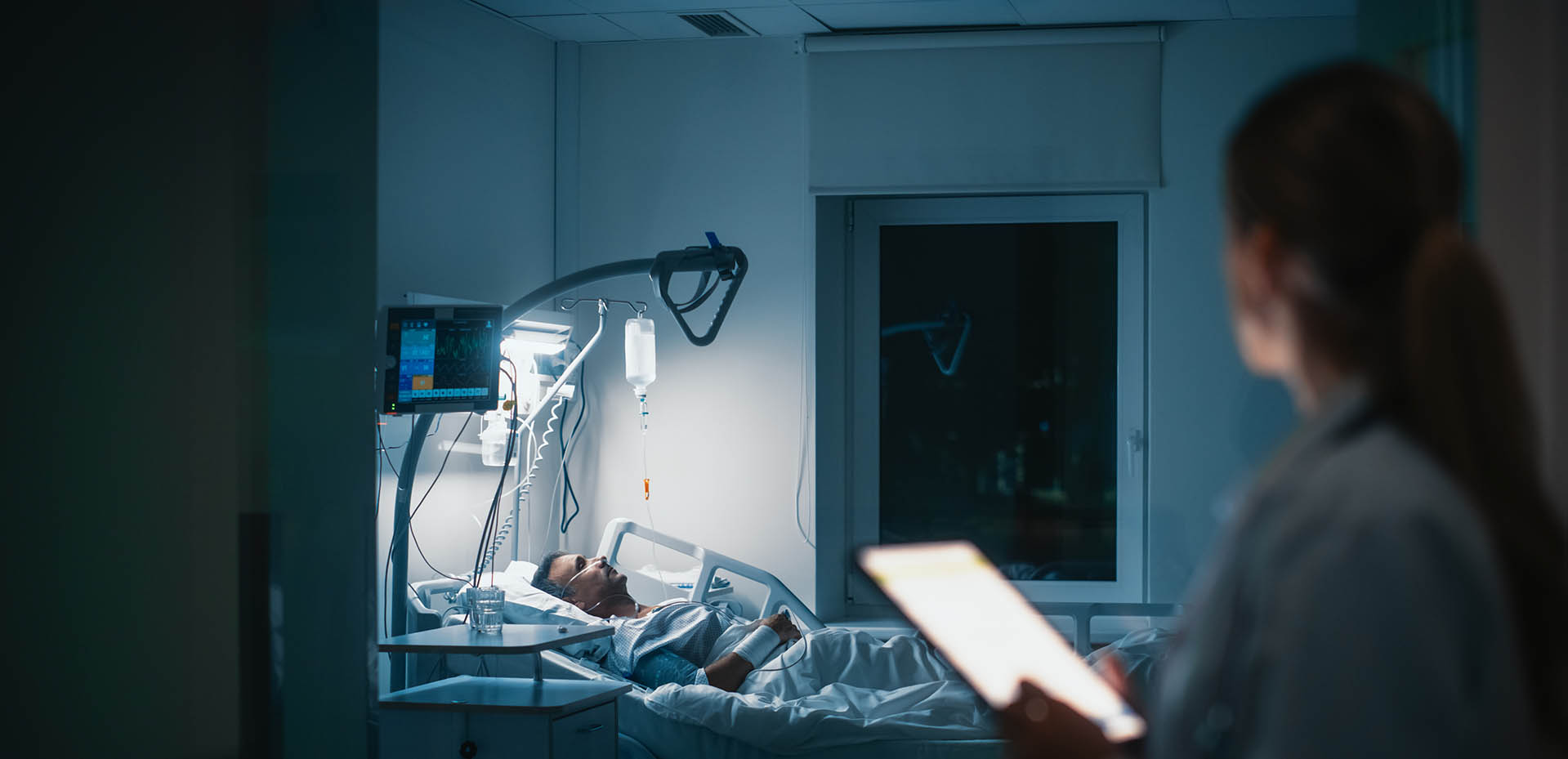

Moving from curative medicine to preventive and personalised medicine
Provide an innovative solution for
early detection and monitoring of infection.
40% of deaths
in intensive care are due to sepsis.10% of patients
treated with chemotherapy develop neutropenia.90% of patients
suffering from neutropenia for more than 7 days will develop a feverAn additional 18% mortality rate
is observed for every hour of delay in the treatment of septic shock.The importance of measuring core body temperature and its variations
As fever is one of the first signs of infection, temperature is one of the constants regularly measured using tympanic, axillary, rectal or non-contact infrared thermometers.
However, scientific literature clearly shows that peripheral measurements (tympanic, axillary, frontal, etc.) remain imprecise, non-standardised and sometimes misleading. The differences can be significant depending on the methods used and there is no clinical consensus on their interpretation. Furthermore, the so-called ‘normal’ value of 37°C does not take into account individual basal temperature.
It is on the basis of this observation that F2D Medical has initiated its research and development programme.
The objective: to make the most reliable measure available continuously and without constraint: CORE BODY TEMPERATURE.
Clinical gold standard targeted: the urethral probe, recognised for its accuracy in critical care settings.
After five years of R&D, clinical trials, scientific boards, algorithm calibrations, etc. Thermodiag has achieved this level of reliability with an average absolute error of 0.35°C.
Not only is the measurement reliable, but the fact that it is available continuously allows it to reflect the patient’s normothermia. While some patients will be feverish at around 38.3°C, others will be feverish at 37.8°C. The slightest variation in temperature is recorded, even at night, so that it can be analysed by the doctor in context.

Medical context
Comparison of temperature measurement methods.

Accuracy and sensitivity are essential criteria for establishing a diagnosis.

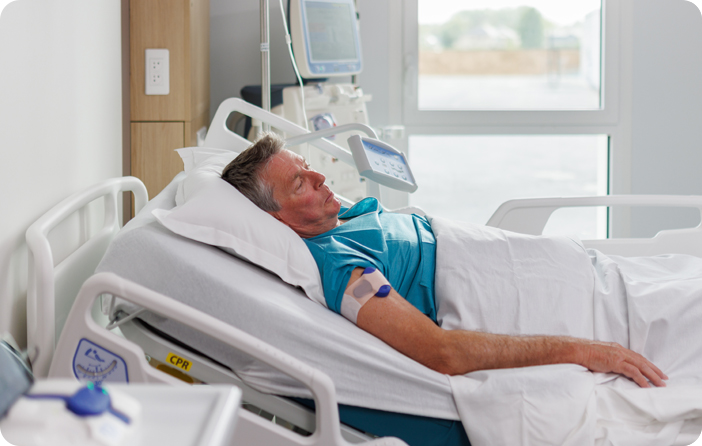
Thermodiag in hospitals: proof of use
Feedback from a pilot project carried out in a hospital oncology department under real care conditions.
Objectives: to measure the integration of Thermodiag into nursing practices, its continuous reliability and its ability to detect fever episodes early in high-risk patients.
Results:
- Fever detected up to 2 hours before the tympanic method,
- Nocturnal fever episodes detected only by Thermodiag,
- Only 1 equipment operation/24 hours vs. 7.3 manual measurements/day on average,
- 100% of data usable except for minor handling errors,
- Total autonomy for nursing staff after brief training,
- Reduction in transcription errors observed up to a 1.04°C difference.
What is sepsis?
Sepsis is an excessive reaction by the immune system to an infection, causing damage to organs. Without rapid detection and appropriate treatment, it can lead to septic shock, multiple organ failure and even death.
Fever, as the first warning sign, must be closely monitored to increase the chances of survival.
What are the temperature thresholds for fever in adults?
It is standard practice to consider an adult to have a fever when their body temperature rises to 38°C in the morning and 38.3°C in the evening. However, several criteria often come into play in the measurement and resulting diagnosis:
- The type of device used and clinical recommendations, which may vary depending on the practitioner, institution or even department (addition of 0.5°C or +0.3°C)
- The patient’s state of health: tympanic temperature may not be reliable if there is a blockage or obstruction in the ear canal, for example.
- The patient’s age: in elderly people, body temperature is often lower. Fever may therefore be absent even in cases of serious infection: a moderate but persistent rise in temperature may then be clinically significant.
According to the WHO, 40% of deaths in intensive care are due to sepsis.

Innovating to detect even earlier
Medicine is evolving towards a more preventive, proactive and patient-centred approach, where continuous data analysis makes it possible to anticipate physiological imbalances before they become clinically apparent.
Thermodiag is fully in line with this dynamic: by recording core body temperature four times per minute and modelling each individual’s circadian rhythm, it identifies subtle deviations from the reference thermal profile. This ability to individualise monitoring paves the way for personalised, responsive and predictive medicine, particularly for patients at high risk of infection.


Estimation of core body temperature using non-invasive sensors
To reliably estimate core body temperature from surface sensor data, F2D Medical has developed, in collaboration with a data science partner, an algorithm based on advanced data processing and statistical learning techniques.
The goal: to achieve a level of accuracy compatible with clinical expectations, while ensuring optimised performance on low-energy embedded Android devices.
Development was structured around several key stages:
- Creation of a multi-sensor database: thermal, optical and inertial sensor signals, synchronised with reference measurements during clinical trials involving more than 300 subjects representative of the adult population in terms of age, gender and morphological diversity
- Development of customised predictive models: several algorithms were tested and refined according to criteria of robustness, interpretability and speed of execution.
- Implementation of a modular architecture: the Thermodiag software includes several complementary models capable of dynamically adapting to different clinical situations (rest, movement, post-operative phase, etc.) to ensure continuous, contextualised and relevant monitoring.
- Secure embedded integration: the algorithms are encapsulated in an Android app that can run locally, without network dependency, with full traceability of predictions. Data can be archived on HDS servers and exported to hospital information systems via secure API or MSSanté messaging.
At the same time, F2D Medical is continuing its R&D work on:
- enriching clinical cases with augmented data,
- specialising predictive models by type of pathology (oncology, intensive care, geriatrics, etc.),
- the integration of intelligent thresholds based on patient profiles to adapt alert messages.
This technological development embodies F2D Medical’s desire to bring together artificial intelligence, clinical precision and operational reality in the field to usher in a new era in the predictive monitoring of patients at high risk of infection.
What is sepsis?
Sepsis is an excessive reaction by the immune system to an infection, causing damage to organs. Without rapid detection and appropriate treatment, it can lead to septic shock, multiple organ failure and even death.
Fever, as the first warning sign, must be closely monitored to increase the chances of survival.
What are the temperature thresholds for fever in adults?
It is standard practice to consider an adult to have a fever when their body temperature rises to 38°C in the morning and 38.3°C in the evening. However, several criteria often come into play in the measurement and resulting diagnosis:
- The type of device used and clinical recommendations, which may vary depending on the practitioner, institution or even department (addition of 0.5°C or +0.3°C)
- The patient’s state of health: tympanic temperature may not be reliable if there is a blockage or obstruction in the ear canal, for example.
- The patient’s age: in elderly people, body temperature is often lower. Fever may therefore be absent even in cases of serious infection: a moderate but persistent rise in temperature may then be clinically significant.
According to the WHO, 40% of deaths in intensive care are due to sepsis.
Thermodiag will be an essential safety tool. This accurate detection is essential for assessing severe infections.Dr Coralie PrebetMedical Oncologist
Being as non-invasive as possible is a constant goal, both for patient comfort and, above all, to limit iatrogenic and infectious risks. Non-invasive measurement of vital signs such as temperature with the accuracy of an invasive device is a real step forward and should become standard practice.Dr Joris GallandDoctor of Internal Medicine
Ultra-portable, lightweight and compact, Thermodiag can be easily transported.Dr Thomas DumontierEmergency Doctor
What is sepsis?
Sepsis is an excessive reaction by the immune system to an infection, causing damage to organs. Without rapid detection and appropriate treatment, it can lead to septic shock, multiple organ failure and even death.
Fever, as the first warning sign, must be closely monitored to increase the chances of survival.
What are the temperature thresholds for fever in adults?
It is standard practice to consider an adult to have a fever when their body temperature rises to 38°C in the morning and 38.3°C in the evening. However, several criteria often come into play in the measurement and resulting diagnosis:
- The type of device used and clinical recommendations, which may vary depending on the practitioner, institution or even department (addition of 0.5°C or +0.3°C)
- The patient’s state of health: tympanic temperature may not be reliable if there is a blockage or obstruction in the ear canal, for example.
- The patient’s age: in elderly people, body temperature is often lower. Fever may therefore be absent even in cases of serious infection: a moderate but persistent rise in temperature may then be clinically significant.
According to the WHO, 40% of deaths in intensive care are due to sepsis.